
Thomas Chatterton Manuscript Project
Life & Works
Thomas Chatterton's
Life, Works & Letters
Contents
Chronologically Presented
Chatterton Family : Panels 1, 1a, 1b, 1c, 1d.
Thomas Chatterton; Timeline of a Short Life : Panel1e
Family Bible - Birth of Chatterton : Panels 2, 2a, 2b, 2c.
First Home & School (age 0-7) : Panels 3, 3a.
Colston School (age 7-14) : Panels 4, 4a, 4b.
Confirmation (age 10-12) - SMR Church : Panel 4c.
Apprenticeship Lambert's (age 14-17) : Panel 5.
Bridge Narrative, C's 1st Rowleyese work : Panel 5a.
Meets Catcott and Barrett (age 15→16): Panel 5b.
Mock Will, his last act at Lambert's : Panel 5c, 5d, 5e.
Gives Gingerbread to his Friends : Panel 6.
Coach and Four Horses, his trip to Shoreditch : Panel 7.
Shoreditch, London : Panels 8, 8a, 8b.
Chatterton's First Letter Home, to His Mother : Panel 9.
Meets William Beckford Lord Mayor : Panel 10.
Narva and Mored. An African Eclogue : Panel 11.
O! Quickly May the Friendly Ruin Fall : Panel 12.
The Death of Nicou. An African Eclogue : Panel 13a.
Chatterton's Last Letter Home (to Mary) : Panel 13b.
Death of Chatterton 25th August 1770 : Panel 14.
Opium Stained Pocket-Book : Panel 14a, 14b, 14c
Bristol Visitors to Chatterton's Death Garrett : Panel 14d.
Herbert Croft visits the Garrett : Panel 14e.
Death of Chatterton in Art : Panel 15a, 15b, 15c.
Panel 1 : ↓ The Chatterton Family (a Montage)

'The Table Of The Chatterton's', direct from page 530 of Meyerstein's 'A Life of Thomas Chatterton'.
Note how unlucky Chatterton's sister Mary was: her husband died when she was 36. She had four children who only managed a total of 30 years of life between them.
"Thomas Chatterton and Sarah Young were married at Sodbury Church in Gloucestershire by Mr Jno. Coats on Monday the 25th day of April in the year 1748." See handwritten entry in the Chatterton family bible

Sarah Chatterton, née Young
Chatterton's Mother

Mary Newton, née Chatterton
Chatterton's Sister

Thomas Chatterton, Jnr.
The Poet

Thomas Chatterton, Snr.
Chatterton's Father
Let me be clear here: there are no portraits of any of the Chatterton family; so this is where poetic licence kicks in and insists that I use the above images to represent the family and put faces to the names.
-
Sarah Chatterton (see panel 1b), is snipped from Henrietta Ward's painting of Chatterton in his lumber room.
-
Thomas Chatterton senior (see panel 1a), is snipped from Montaigne's painting of Chatterton asking for a cup to be painted with an angel and a trumpet to blow his name about. The image is of a man (a representation of a family member? Not really possible) offering the cup to Chatterton.
-
Mary Newton, née Chatterton (see panel 1c), is more of a problem, as she has not been included in any of the paintings relating to Chatterton. So I have used a portrait of the famous actress Ruth Chatterton (1892-1961). After all, Ruth pops up incessantly whenever I search online for anything related to Chatterton. I think it is fair to say that she is a 'True Chatterton', for who is to say that she is not distantly related to the Chatterton clan of Bristol. I like to think that she is playing her final acting role 63 years after her death.
AI with care : In the spirit of honesty and clarity, I must mention that 'Mary's portrait' is the result of a silly little experiment; I asked AI to make a portrait of Mary using Ruth Chatterton as the base image, followed by tweaking the portrait to take on the features of the famous 'portrait' of Chatterton used in Dix, and there you have it. AI is difficult to avoid because it is being foisted upon us surreptitiously. It is possible that we are all doomed, so use it with extreme care, and if you publish always state clearly if AI has been used; I promise that I will.
-
Thomas Chatterton, the Poet (see panel 2 & all other panels), is, of course, the infamous portrait used by John Dix in his book 'The Life of Thomas Chatterton.'
-
Giles Malpas Chatterton (see panel 1d), was Chatterton's brother, he died very soon after birth.
-
Grandmother Chatterton, she lived with the family. It is not known if the grandma was a paternal or maternal grandma, however, the general opinion (for what that's worth) is that the grandma was paternal. Edward Bell in his Memoir of Chatterton for Skeat's The Works of Chatterton, 1871, p.xvii, states that the grandmother is Sarah's mother-in-law (how does he know?).
-
Chatterton, derivation of the name : Meyerstein covers this question in his 'A Life of Thomas Chatterton', 1930'. Read Meyerstein's Original MS., page 1.
The gravestone shown below, was made to replace the original gravestone commemorating the Chatterton family. It has confirmation of the actual known dates used in these pages.
The images are from Find a Grave. I am awaiting a reply to my request to use them on this page.


The replacement memorial stone for the Chatterton family was installed in the graveyard of St Mary Redcliffe in 1853, all paid for and arranged by Sholto Vere Hare. It replaced the original stone, which had 'fallen into decay'. The first image is of the upper-part of the stone, the second is of the lower-part. Sholto Vere Hare, a future Lord Mayor of Bristol, paid for the whole project.

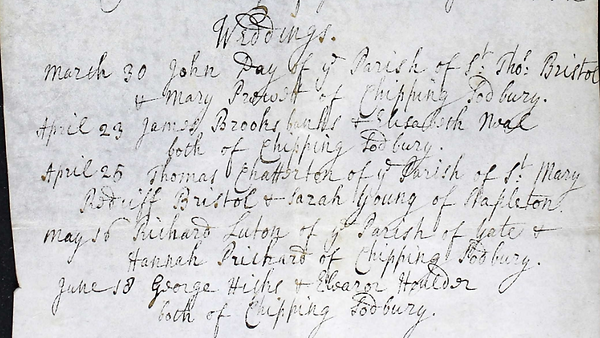
The Record of the Marriage of Thomas and Sarah in Chipping Sodbury in 1749
A Transcript from the Register Book of Chipping Sodbury for the year 1749.

The Record of the Burial of Sarah Chatterton in St Mary Redcliffe, 28 December 1791
From the St Mary Redcliffe Register for 1791/2
Panel 1a : ↓ Thomas Chatterton Senior. Back to Top
Thomas Chatterton, Snr.
8/08/1713-3/08/1752
Chatterton's Father
According to John Ingram, author of 'The True Chatterton' :
"...Thomas Chatterton senior, born in 1713, was the first member of the family known to have attained to any higher position...By his abilities he raised himself above the circumscribed position of his race. He possessed loftier aspirations and was more talented and better educated than were his immediate progenitors. An interesting fact respecting this Thomas Chatterton, which has not been previously made known, is that he was educated at the same public school in which his famous son afterwards spent nearly eight years of his short life.
This senior Thomas Chatterton, of the parish of St. Mary Redcliff, was placed upon the foundation of Colston's Hospital, on January 21, 1722, he being nearly nine years old. He was nominated by the executors of the founder, Mr. Colston. The records contain no notices of his school career, but state that on leaving the establishment, on September 5, 1729, he was apprenticed to a Captain Ed. Saunders, evidently the Edmund Saunders described in the Bristol Poll Books for 1772 and 1734 as a " Freeholder of the Parish of St. Mary Redclift."
It is said the senior Chatterton's elegant handwriting subsequently procured him a situation with a firm of London solicitors, by whom he was employed in engrossing deeds, and that afterwards he became writing-master in a classical school, where he acquired a knowledge of Latin.
He is described as "Writing Master, St. Mary Redcliff," in a Bristol Poll Book for 1739, and during that year he was appointed master of the Pile Street Free School, a position he held until his death on August 7, 1752.
Being well versed in music the schoolmaster employed his leisure time in writing out pieces for use in the Cathedral, where his talents procured him a lay clerkship. His appointment by the Dean and Chapter as one of the Chaunters in the Bristol Cathedral is dated January, 1745.
Chatterton [the father] was a composer of music himself, but in a small way, if the accompanying "catch" for three voices is to be regarded as a fair specimen of his capabilities. It is said to have been composed by him in commemoration of certain festivities held periodically in a Bristol tavern designated " The Pine Apple." This catch may not fully justify the character given Chatterton by a contemporary, of " a complete master of the theory and practice of music," but can be accepted as a proof that he did possess some knowledge of his profession. The catch is given so that its author's musical powers may be gauged by the reader"
Reference: Ingram, The True Chatterton p.19


A Catch for Three Voices. European Magazine, March 1792 : View online
Thomas Chatterton senior, 8/08/1713 - 3/08/1752, was baptised August 19, 1713 (Meyerstein p.3, & SMR register).
He entered Colston's Hospital School, January 21, 1722, and was placed apprentice to Captain Edmund Saunders, on September 29, 1729.
Saunders (a ships Captain), was also a slave trader. He lived in 10 Guinea Street, Redcliffe Hill, which is close by St Mary Redcliffe Church. The street was named after one of the prime sources for slaves, the Guinea Coast. View his house, (note that there is no sound to this video, all you get is a view of the front of the house). In the face of such a horrendous trade, young Chatterton, the poet, was anti-slavery : View his African Eclogues
In Chatterton's time you didn't get to choose who you would be apprenticed to. Apprenticeship Indentures were legal contracts binding the apprentice to the master. Apprentices were typically forbidden from marrying, gambling, visiting taverns, or staying out late without permission. Apprenticeships generally lasted seven years, legally ending when the apprentice reached 21 years of age.
In 1738 Chatterton senior succeeded William Wallice as master of a school in Chipping Sodbury. In 1739 he was appointed master of Pile Street School.
He married Sarah Young, April 25, 1748, in Chipping Sodbury, and had three children: Mary; Giles Malpas; and Thomas.
Panel 1b : ↓ Sarah Chatterton. Back to Top
Sarah Chatterton, née Young
16/12/1731 - 25/12/1791
Chatterton's Mother
Relaying this entry 14/10/26
Sarah Young was born 16/12/1731, she married Thomas Chatterton at Sodbury Church in Gloucestershire on the 25th April, 1748, by Mr Jno. Coats. She died Dec 25th 1791, aged sixty one (Meyerstein p.489n), and was buried 2812/1791 (Redcliffe Register (Burials).
Sarah was 21 years old , and six months pregnant with Thomas (our poet), when, on the 3rd August 1752, her husband Thomas Chatterton senior died. She now faced an uncertain future. She had already given birth twice before. Her first child, Mary, was Born on the 14th February, 1749. Her second, Giles Malpas, was born on the 12th December 1750, but died only 4 months and 4 days later, on April 16, 1751.
The family, according to the DNB (Dictionary of National Biography), '...early in 1753 [her son Thomas, was born 20/11/1752] removed to a house on Redcliffe Hill, [where Sarah] opened a dame's school, and took in sewing. Mrs. Chatterton, the poet's grandmother, and Mrs. Edkins, formerly Miss James, who assisted Mrs. Chatterton as a sempstress, and who is usually spoken of as Chatterton's foster-mother, lived with the family. They soon removed to a smaller house, up a court, at the back of No. 50, thenceforth memorable as Chatterton's home at Bristol.'
However, the DNB contradicts a differing view that the family remained in the Pile Street masters house until 1757, when the new master, Mr love, needed the house for his own family.
It must have been a truly frightening and stressful time for her as she also stood to lose the family home, which came with the position of master of the school. Fortunately, a little luck came her way, as Mr Chard, the new Master of the school, was not a family man, and chose to remain in his own house rather than move to the master's house. However, Mr Chard retired in 1757 and was succeeded by Mr Love who needed the house for his own family. So, it seems that the Chatterton family lived in the schoolhouse from 1749 to 1757, they then moved, probably to a house by the upper gate of St Mary Redcliffe. Although it is also said that they moved in 1753, and not 1757.
Poor Sarah had problems aplenty already and Mr Love added to her woes by rejecting Chatterton, saying that he was a dull boy, incapable of learning. Sarah was left with two children to care for, as well as working to support the family. Fortunately, three years later, in 1760, Colston's Hospital School accepted young Thomas as a pupil, complete with a built-in apprenticeship.
Thomas Chatterton's Letters to His Mother.
(There are no known letters from his mother)
To Sarah Chatterton, May 6, 1770 : View
Includes messages to the following :
Thomas Cary ; Henry Kator ; William Smith
Mrs Baker; Mrs Mason; Mr Mat Mease ;
Thaire ; Rudhall ; Ward ; Gaster
Thomas ; Kalo ; A. Broughton ; Carty;
Smith, &c, &c, &c.
J Broughton ; Hanmor ; Williams ; Vaughan
To Sarah Chatterton, 14 May 1770 : View
To Sarah Chatterton, 26th April 1770 : View
To Sarah Chatterton, 8 July 1770 : View
Panel 1c : ↓ Mary Chatterton Back to Top
Mary Newton, née Chatterton
14/02/1748/9 - 1804
Chatterton's Sister

Mary's Godmother's surname was 'Arden' the same as Shakespeare's mother's maiden name.
References : Redcliffe register (M, p.9)
Mary had four children.
Her date of death was 1804. (Meyerstein, states 1804, which agrees with the gravestone in Si Mary Redcliffe. However, George Pryce has 1807, which he gets from an interview with an intimate friend of Mary's, Fact v Fiction, 1858)
The Public Advertiser 8th June 1772, Has the earliest printing of Mary’s anecdote re the cup and angel with a trumpet.
Thomas Chatterton's Letters to His Sister
(There are no known letters from his sister)
Panel 1d : ↓ Giles Malpas Chatterton

Giles Malpas Chatterton, second child of Thomas and Sarah Chatterton. Giles Malpas was named after the man who donated the funds to build the house for the school master and his family.
Born 12/12/1750, baptised 1/01/1751, died 16 April 1751, aged 4 months 4 days (see family bible entry above).
It is safe to say that the above entry in the family bible was written by Thomas Chatterton's father.
Panel 1e : ↓ Thomas Chatterton, poet : Timeline of Chatterton's Short Life

The following Timeline of Chatterton's short life might help to forgive the Rowleians who insisted that Rowley was the actual author of Chatterton's works. To them it seemed impossible that a lad of Chatterton's age could have produced such an amazing body of work in such a short period of time :
Chatterton's short life lasted from 20 November 1752 to 24/25 August 1770.
A bald and stark statement of a tiny existence - a total of 17 years and 9 months.
When you break it down it becomes truly stark:
At 5 or 6 years of age he was placed in the Pile Street Charity school, but lasted only 4 weeks after being rejected as being too dull to learn: ...Read more.
He spent the next 109 weeks at home without formal education. It is clear to me that Chatterton's mother, Sarah, who Basil Cottle called a nonentity (I assume he meant from an historic point of view), was a force in Chatterton's life. It is clear too that Chatterton had an enquiring mind and would have kept his mother busy with continuous questions. It seems that she had a plan for his future education and managed, somehow, to get him enrolled into Colston's Charity School.
This phase, as a pupil at Colston's Charity School, saw him practically 'imprisoned' for 359 weeks, for Colston's was a boarding school where only basic education was taught, consisting of reading, writing, accounts and maths, along with religious indoctrination - just enough education to ready him for his future occupation as an apprentice scrivener : ...Read more of Chatterton's time at Colston's School.
On the 1st July 1767, the day after he left Colston's, his 'imprisonment' continued when he started his unpaid apprenticeship as a Scrivener's apprentice at Lambert's, a Bristol attorney. He was also required to lodge at Lambert's house, sharing a bed with another boy. However, his apprenticeship was cancelled after just 143 weeks : ...Read more.
It is clear that he engineered the cancellation of his apprenticeship indentures. He was now free to start the next chapter of his life. Which began with a move to London. So he moved to Shoreditch, where he shared a room & a bed with the son of a relative, Mrs Ballance; this stopover lasted just 37 days : ...Read more.
Now came his final move, he took an attic room in Mrs Angel's house, in Brooke Street, Holborn, London : ...Read more. At last he had some privacy - but his freedom lasted just 85 days and he died on the 24th / 25th August 1770! ...Read more.
His was a short life indeed, but as short as it was he still got his wish to have his name blown about the world; his fame reached many countries and has stretched across the centuries. And it is still happening; in 2010 Ackroyd's novel 'Chatterton' was published in Russia. Not bad for a poet who was 'But a boy!'
Panel 2 : ↓ Family Bible. (Rediscovered in 1881)
MS. Details of the Chatterton Family Back to Top
A Compleat History of the Holy Bible
Containing a handwritten record of
Chatterton's arrival into the World.


Record of the birth of Thomas Chatterton
Lost for over 100 years and fortuitously rediscovered in 1881, this dilapidated old Bible, which is missing many pages, is for the first time available for online viewing or research, or perhaps just for the sheer joy of it! This hugely important book contains two pages of handwritten details of the Chatterton family.
It is likely that some of the entries were written by young Thomas Chatterton himself. He was proud of his family and certainly did some research into his own family history.
The newly discovered bible created a lot of fuss in Bristol and further afield, with especially vitriolic arguments between John Taylor, a Bristol librarian & author, and John Ingram, author of The Life of Thomas Chatterton (1910). Their arguments for and against the genuineness of the entries in the bible, were played out in The Athanaeum, an important academic magazine of the day.
Read on to immerse yourself in the argy-bargy, it is a wonder to behold - why anyone would read a novel when a ringside seat is available to live through the events of the 1880s is beyond me - this is time travel at its best!


William George, a famous Bristol bookseller & publisher, joined the argument on the side of John Taylor, and published a pamphlet on the disagreement : New Facts Relating to The Chatterton Family : View.
William George was the last owner of the bible. His children donated it to Bristol in 1900. It is now in the care of Bristol Reference Library.
It would be useful to know the provenance of the bible, and to determine when the horrendous staining occurred. What I can say is that George Symes Catcott once had his hands on the bible, a fact that appears to have been unknown to William George, John Taylor, or John Ingram.
Panel 2b : ↓ Catcott's Transcript of Chatterton's entry in the Family Bible Back to Top
↓ George Catcott's Transcript of Chatterton's entry in the Family Bible.

Transcript by (QE!) ↓ of Catcott's 'memorandum' above:.
'The underwritten Satirical Lines were composed by Thomas
Chatterton, when little more than eleven years old, as ap-
-pears from the following memorandum extracted=
from his Father's Ms in a blank Leaf of a Family =
Bible Viz: Thomas the son of Thomas & Sarah Chatt
-erton was born November 20th 1752. On a Monday Night
between 6 & 7 O Clock, and was baptiz'd at Saint Mary Red-
-cliff Church the first Day of January following. Full
moon 22nd at 3 in the afternoon.'
(QE!) : The satirical lines referred to are Apostate Will.
Don't you just love a bit of research ? If you do, click the link below, which takes you to the whole page in Catcott's B5342 Copy-Book. The other link takes you to the Chatterton Family Bible, which allows you to compare the two :
Catcott Copy-Book B5342 : View
Chatterton Family Bible : View
Obviously, George is wrong in his assertion that Chatterton's father made the entry, bearing in mind that he died 3 months before his son was born - does this mean that John Taylor did know of George Catcott's note regarding the bible? A small point but worth considering.
Catcott died 80 years before the bible was rediscovered. I believe that Catcott, who has confused dates in the past, has gone directly to Sarah, Chatterton's mother, to ask her to confirm the details of Chatterton's birth. I can see her and hear her response '...of course Mr Catcott, would you like to read the page in our family bible, wherein the details of my son are written?'
The family bible is also mentioned by Jeremiah Milles in his 1782 edition of 'Rowley's' Works, where he describes Chatterton discovering one of the parchments, which his father had used to cover Clarke's History of the Bible. I must say that Jeremiah's book is a favourite of mine, but mainly for the quality of the paper used.
Here's the Original in Catcott's Handwriting.
Panel 2c : ↓ The Chatterton Family Bible - Analysis & Reconstruction

The heavily stained pages of the bible can be seen above. What made the stains? Were they caused by a mixture of arsenic & opium? How old are the stains, and are they coincidental with Chatterton's Opium Stained Notebook? The stains in the bible are of a darker colour than the notebook, but perhaps this might be due to the type of paper used.
I have been working with 18th century books for the last 30 years and have never seen the like before. This is probably because a book so badly stained and damaged would be thrown out - would you put a book like this on your bookshelves?
The handwritten entries seem to have been made by more than one person. There are five possibilities: Chatterton's Mother & Father; his sister, Mary; his Grandmother (unlikely) ; and young Thomas himself. The big question is, does the Bible contain the earliest sample of the handwriting of Thomas Chatterton? You must examine the manuscript pages and decide for yourself.
The Chatterton Family Bible is stated to be the 1737 edition but I wonder if this claim is correct? There are three editions (as far as I know), 1737, 1739, & 1740.
The problem with the Chatterton family bible is that it is missing a lot of pages and some engravings; including the title page with its date of publication.
Chatterton learned his ABC from an old French Music Folio but was taught to read using the family bible. It would be interesting to see the bible in its original condition to determine Chatterton's earliest influences - the missing engravings are key to this.
Over the last few years I have obtained copies of the 1739 & 1740 editions of the bible, and have recently added the 1737 edition to the set. The idea is to compare and collate the three editions with the remains of the Chatterton family bible and, with luck, recreate whichever edition the Chatterton bible resolves itself to be!
The reconstruction starts below :-
If the Chatterton bible is the 1737 edition you can now see the missing title page in all its glory (from another copy in my possession).
Ah! but wait - the added complication is that the bible comes in two volumes, sometimes bound as one, sometimes not, and each volume has its own title page. You will often find that the two volumes are of mixed dates, volume 1 might be 1737, and volume two might be 1739, for example.


I would be very surprised if this rather wonderful engraving of 'The Creation of the World,' didn't influence Chatterton; always supposing, of course, that the edition owned by the family really was the 1737.
I should add that this is not a 'BlackLetter' Bible, as many commentators have stated.
A 'blackletter' book uses gothic type that fills the page and makes it hard to read. However, some bibles print the word of God in red and the rest of the script in black and would be known as a red-letter bible, whereas a bible using only black type would be known as a black-letter-bible, even without the gothic type. In the case of the commentators mentioned above, I am fairly sure they are referring to a bible with gothic print. The Chatterton bible uses gothic print on only one line of text, on the title page. I hope that's clear now!
Panel 3 : ↓ Chatterton's First Home & School

Chatterton's house (left).
Schoolhouse (rear) - right of chimney

The Schoolhouse from the front.


Gallery
Click for larger image
Pile (or Pyle) Street Charity School has an unusual history; it was built in 1739, and continued as you see it in the slideshow above, image 3. There were no major changes until the early 1930’s, when the rear and side walls were demolished and replaced with a new structure, which was added to the existing facade.
Then, around 1938, the whole of the school building was demolished, along with many other buildings, see image 5 (Bristol Library photo). This shows the complex of buildings enclosing the school, (marked No.1 in the photo), and the schoolmaster's house, built in 1749 (marked No. 2 in the photo).
However, the stones forming the facade were marked and kept in readiness to rebuild it, still at right angles to the Master’s house, but now practically butted up against it. Images 13 and 14, show the house and the facade of the school in 1955, with the railway sidings running right up to St Mary Redcliffe.
To see the changes to the area around Pile Street over the years, click the link to Redcliffe Maps., where you will find six maps to view: Map 1, 1746-1803; Map 2, 1844-1888 OS 1st edition; Map 3, 1855 Ashmead; Map 4, 1874 Ashmead; Map 5, 1894-1903 OS; Map 6, 1898-1939 OS 3rd edition - it all takes a little effort to figure it out but it is worth a try anyway.
Panel 3a : ↓ Where did Chatterton live after 1757 ?

Stereoview St Mary Redcliffe
According to James Ross, the City of Bristol Librarian, Chatterton's family moved to a smaller house somewhere on Redcliffe Hill, near the Upper Gate of the Church. The stereo view image shows the Upper Gate before 1872 (when the spire was rebuilt).
The aerial view below shows an Upper Gate at both corners of the church. The buildings in the photo below are from a later date than Chatterton's time. Some of the buildings surrounding the church were destroyed during the air raids of WW2.
Click the link to learn how to view the image above in '3D' without the aid of a viewer, or buy a stereo viewer online.

Aerial View St Mary Redcliffe
Panel 4 : ↓ Colston's Hospital School : Age : 7-14
While at Colston's
Works : View
(No Correspondence)


It starts with his registration in the school register for 3rd August 1760. It is worth noting that Chatterton was rejected from Pile Street School in 1757 for being too dull to learn, but now he has been nominated by 'John Lambert, Attorney, (or you might say, that 'John Lambert, Attorney' has staked his claim on Chatterton as his property and drudge, as a scrivener, to serve an apprenticeship of seven years from the 1st July 1767, immediately upon the end of his seven years stint at Colston's Hospital School. Now that is forward planning.
To read more on Chatterton's time at Colston's, see John Ingram's 'The True Chatterton,' the link takes you directly to the chapter about Colston's. You might also read The Life of Thomas Chatterton by George Gregory, 1789, which is preferred by Meyerstein. Alternatively, go to our 'Biographies & Works' page, where you will find links to almost all of the biographies of Chatterton from 1780 onwards.
There are, potentially, 22 possible works to consider as Chatterton's, while Chatterton was at Colston's, although only three or four are regarded as authentic. The others include four or five marked as works of doubtful authenticity, two presumed lost, and twelve wrongly attributed.
Surely, considering the regime at Colston's, there can be no surprise if Chatterton did manage only four authentic works over the nearly seven years he spent at the school.
Panel 4a : ↓ Colston School - Delight & Disappointment

Colston's Great House, On St Augustine's Back, Bristol.
The Great House, which became Colston's Charity School, is no more. The Colston Hall, which stands on the original site, has been rebuilt at a cost of some £132 million, and has been renamed The Bristol Beacon.
Chatterton was only a few months short of his eighth birthday, and must have been looking forward to this new episode in his life, he was, perhaps, full of hope for what lay ahead.
But, on his first day at Colston's School, Sunday 3rd of August 1760, Chatterton's hopes were dashed. He soon discovered that the lessons were basic and provided just enough education to ready him for his apprenticeship. The following quote from A Mirror for the Burgesses and Commonalty of the City of Bristol, 1818, is clear enough :
"In 1708, Edward Colston, Esquire, erected a school for a master, two ushers, and one hundred boys, to be clothed, maintained, and instructed in reading, writing and arithmetic, and in the church catechism, from seven years old until they are fourteen ; when they are to be placed out apprentices ; he allowing £10 to each at their going out".
Suddenly he had gone from being a free spirit, able to wander as he pleased, to near 'imprisonment' as a border, in bed at 8 pm summer or winter. It is no surprise that Chatterton is said to have stated that he could "learn more at home from books."
Panel 4b : ↓ A Colston's Schoolboy


The traditional uniform at Colston's included a badge of brass, for everyday wear, and a silver one for special occasions.
There is some confusion regarding the dates that the badges were first worn by the boys; John Wroughton's book, Mr Colston's Hospital..., seems to say that silver badges were worn from the start, p.58. It also mentions a gift of 100 silver badges in 1776, from John Purrier, an old boy of the school (1743-1751), and also 100 brass badges in 1800, from Mr Collier.
However, in Meyerstein's A Life of Thomas Chatterton, p.36, it states that there were no silver badges before Mr Purrier's gift in 1776, indicating that the badges were brass from the outset, which, considering it was a charity school, makes perfect sense.
There is a delightful story about the introduction of the Dolphin to Colston's coat of arms, and it's subsequent use as the symbol on the school badge :
"This had apparently been chosen by Colston (and used on his coat of arms) after one of his ships, returning from the West Indies with a valuable cargo, had been seriously holed. The water was already rising rapidly, when, by chance, a dolphin accidentally became stuck in the damaged hull, thus stemming the flow and saving both crew and cargo."
To add to the confusion, "A Mirror for the Burgesses and Commonalty of the City of Bristol...," published 1818, also mentions "the gift of John Purrier". It states that silver badges were introduced, around 1782, (which sounds like guesswork and should, perhaps, be ignored).
So it seems that not everyone disliked the education at Colston's.
To round up the story of the brass and silver badges, I offer the following images :

The image above (designed by Nicholas Pocock), shows Chatterton wearing the uniform of Colston's School, complete with a dolphin badge. Is it brass or silver? The image is from Richard Jenkins', "Odes, Songs, Choruses, etc., for the Concert in Commemoration of Chatterton," 1784. This is possibly the earliest image showing the wearing of the badge.
St Mary Redcliffe Church, without its spire, looms large in the background.


The two images above are of Colston boys standing guard at the gateway to the school. The badges have the appearance of being silver. The artist was Samuel Griffiths Tovey (1808-1873), it is said that he did various works on commission for Braikenridge, in the 1840s, or 50s...read more
Panel 4c : ↓ Chatterton's Confirmation at St Mary Redcliffe
During his time at Colston's, Chatterton had his Confirmation in St Mary Redcliffe Church. The date is uncertain but it was sometime between 1762-1764, ...read more
Panel 5 : ↓ Apprenticeship at Lambert's with Links to Works : 1/07/1767 - 14/04/ 1770 Back to Top

Lambert's Office, Corne St.

Millerd's Map of Bristol 1671
Lambert's office was on Corne Street (these days known as Corn St). It is shown above on Millerd's map from 'F' to 'E' (the left arm of the crossroads). The Old Bristol Bridge can be seen at the bottom of the map, complete with houses and workshops. The replacement of such an important bridge, in 1768, was a major event in Bristol, and inspired Chatterton to write what became his first published Rowlean Work.
Apprenticeship Indenture
(QE!) : This rather fabulous document, consists of a single leaf with Chatterton's signature on the recto and his mother's signature on the verso. The ink is a little faded, so I have transcribed the two pages below. All of the handwritten additions on the recto of the document are transcribed in red :

Recto with Chatterton's Signature
Transcript of the Recto Ms. above :
City of Bristol, to wit. This Indenture made the first day of July in the Year of our Lord One Thousand Seven Hundred and Sixty Seven. Witnesseth, That Thomas Chatterton, son of Thomas Chatterton late of the City of Bristol, School master deceased, hath put himself Apprentice to John Lambert of the same City Gentleman to be educated a Scrivener and doth covenant with him to dwell, and him after the Manner of an Apprentice, as well in the Art aforesaid, as in all other Arts and lawful Commands, with him faithfully to serve, from the Day of the Date of these Presents, for and during the Term of SEVEN Years next ensuing : During which said Term, the said Apprentice, the Secrets of his said Master shall keep his Goods he shall not inordinately waste, Taverns he shall not frequent, at Dice he shall not play, Fornication he shall not commit, Matrimony he shall not contract, or Damage to his said Master within the said Term he shall not do ; but well and faithfully shall behave himself in all Things, as well in Words as Deeds, as a good and faithful Apprentice, according to the Use and Custom of Bristol, for the whole Term aforesaid : And the said Master his said Apprentice, as well in the Art aforesaid, as in all other Arts which he now useth or hereafter shall use, shall diligently teach, instruct and inform, or cause to be informed by others, and shall find him good and sufficient Meat, Drink, Linen, Woollen, Lodging and all other Necessaries (washing and mending excepted) during the said Term : And at the End of the said Term, shall pay to the said Apprentice Four Shillings and Sixpence towards his Freedom of BRISTOL, with Two Suits of Apparel one for Holy days and the other in Lieu of his Salary.
In Witness whereof, the Parties first above-named to these present Indentures have interchangeably set their Hands and Seals. Witness William Barnes the Younger Esq: Mayor of the said City, and William Miles and Henry Cruger the Younger Esquires, Sheriffs, of the same, the Day and Year above-written.
Witness { Paid with the Apprentice }
{ Ten pounds the Gift of Edward }
{ Colston Esq deceased }
{ John Mc Arthur }
Elton Town-Clerk.
Thomas Chatterton

Verso with Sarah Chatterton's Signature
Transcript of the Verso Ms. :
Memdm? [memorandum] that at the time of the execution of the within Indenture
It was agreed by deed between the within parties that the friends or
Relations of the within Apprentice shall at their own expense find
and provide for him washing and mending during the within
Term any thing within contained or custom of Bristol to the
contrary notwithstanding. Sarah Chatterton
Witness
John McArthur
Panel 5a : ↓ First Time in Print of a 'Rowley' Work Back to Top
"The Mayor's first Passing over the Old Bridge,
Taken from an old Manuscript"
by Dunhelmus Bristoliensis*
(aka : The Bridge Narrative)
*Dunhelmus Bristoliensis was one of Chatterton's pen names.
It was also used by Catcott when trying to manipulate the press.
It's a momentous occasion for Chatterton; the first time in print of one of his Rowley works.
It was published anonymously, 1st October 1768, in Felix Farley's Bristol Journal :

Bristol Bridge in Olden Times

Bristol Bridge Rebuilt 1768

The original manuscript of The Mayor's First Passing over the Old Bridge, included two 'Songes,' which the Bristol Journal chose not to include. I am guessing that lack of space was the problem. I have rectified the omission with handwritten transcripts by Catcott of the two 'Songes.' Click the image above to go to the Control Page for The Mayor's First Passing...., which includes the Songe of Saincte Werburgh, and the Songe of Sayncte Baldwyn. I will include copies of Chatterton's originals in due course (I don't have them at the moment).
Panel 5b : ↓ Chatterton meets Catcott & Barrett.


The Bridge story was to bring Chatterton, Catcott, & Barrett, the main players in the Chatterton-Rowley story, together for the first time. It was the catalyst that would affect their lives more than they could have imagined. When they first met, Chatterton was not yet 16, Barrett was 35, and Catcott was 39.
The big question is: how much of a role did they individually, or jointly, play in the creation, development and afterlife of the Rowley phenomenon? To read more on this subject, see Biographies of Chatterton : View
Panel 5c : ↓ Chatterton's Last Act at Lambert's : His (Mock) Last Will & Testament

Chatterton's Original Manuscript of his 'Mock' Will : View
(Complete with a transcript by (QE!))
Chatterton, according to his sister, had only two hours of work at Lambert's each day, leaving plenty of time to surreptitiously write his poems and other works; in fact he wrote more than 160 works, which equates to at least one piece of work every six days.
John Ingram, one of Chatterton's biographers, describes Chatterton's routine at Lambert's, as follows :
"At that time Lambert's office was in Small Street, some distance from his private residence, where his new apprentice had to sleep and return to daily for his mid-day meal. He had to be at the office by eight in the morning, go back to Lambert's for dinner, and then return to the office till eight in the evening, when he was free for two hours. As soon as he left the office Chatterton would hurry home to his mother and stay with her during the evening, leaving in time to be back at his master's by ten. Despite the dislike Lambert grew to entertain for his apprentice, he was obliged to acknowledge that the lad was invariably regular and punctual in his attendance, and only once during the whole period of his servitude exceeded his stipulated time for returning, and then he had obtained special permission to spend the evening, it being Christmas, with his mother, who was entertaining some friends.....To be certain that his apprentice did not desert his post during office hours the footman and other servants were often sent round to inspect, and they had always to report that they found the lad there and hard at work. Naturally, neither the footman nor the other servants were judges of the work going on and would not know whether Chatterton was writing verse or occupied with usual office routine. "
"The poet was greatly troubled at having to take his meals with the servants, who probably did not appreciate his company any more than he did theirs, and, still worse infliction for the poet, he had to sleep with the footboy."
"Not only would the proud spirit of his race blaze up at these seeming indignities, but the presence of the footboy in his bedchamber must have been a serious inconvenience to one who had reached a climax in his career when solitude was an essential factor in his poetic plans. So full of irrepressible energy and indefatigable zeal was Chatterton now that the many hours he had at the office for carrying on his poetic labours did not suffice for his requirements, and he is stated by his sister to have frequently sat up the whole night writing, especially towards the full of the moon, when he believed he could compose better. "
Imagine being alone for the majority of a 12 hour day on every working day of the week. Is it any wonder that he was looking for a way out of his suffocating and demeaning apprenticeship? He had already served two years, nine months & thirteen days, with more than four years still to serve, so he wrote his own (mock) Last Will & Testament and left it on his desk for Lambert to find. It seems that Chatterton was a good judge of character, he was sure that it would frighten Lambert enough to get his freedom. He had read Lambert perfectly, for when Lambert found the 'Will' he was so shocked he dismissed Chatterton immediately - this was on or about the 14th April 1770.
Chatterton was now free to make his own way in the world. It was a brave step to take in a world without a Social Security safety net, but it seems he had great faith in his own abilities and had, in fact, been testing the waters of the career he had in mind - writing for the various magazines of the day. Manipulation is the key here, just as it has been 'time out of mind' and as it continues to be in our own time - look around you we are awash with manipulation.
To read more about Chatterton's time at Lambert's, see John Ingram's 'The True Chatterton,' published in 1910, the link takes you directly to the apprenticeship chapter in Ingram's book : View
Another option is to go to the Biographies & Works page, at the Manuscript Project website where you will find links to almost all of the biographies of Chatterton from 1780 onwards : View
Chatterton's Will may have been modelled on Samuel Derrick's own 'Mock Will', which follows on below.
Panel 5d : ↓ Samuel Derrick's 'Will ' Back to Top


engraving of Samuel Derrick from NPG

Samuel Derrick, Master of the Ceremonies

Engraving from Town and Country Magazine Samuel Derrick
engraving of Samuel Derrick from NPG
Samuel Derrick
Meyerstein suggests that Chatterton was influenced to write his 'mock' Will after reading Samuel Derrick's Will, which was printed in the April 1769 issue of the T&CM (Town & Country Magazine). According to Meyerstein, Samuel Derrick's Will derives from the 'Will' of Isaac Bickerstaff, in the Tatler, pp.66-72, which dates to 1709.
My question, based on the fact that Samuel was dead and buried by the 2nd April 1769 (or was he?), is on the genuineness or otherwise of his Will. It seems to me that the character of the man dictates that a vein of humour would even weave its way through his Last Will & Testament - a chance too tempting to pass up, perhaps! Or was it written by the editor of the magazine - after all, the dead don't talk!
All in all, a very interesting edition of the T&CM.
This same monthly issue contains two of Chatterton's works : pp. 174/5; 217;
It also contains an Epilogue...Written by Mr. Walpole, which appears on the very next page (p.218), so close and yet too far to make a difference!
Panel 5e : ↓ Catcott's Transcript's of Chatterton's Will Back to Top

Panel 6 : ↓ Gives Gingerbread to his Friends. A final goodbye before leaving Bristol for good.

North Porch, St Mary Redcliffe Church
It was on the steps of St Mary Redcliffe, on Saturday 21st April 1770, that Chatterton famously distributed gingerbread to his friends and to the local children.
According to Meyerstein, Chatterton went over the way to Mr Freeling's shop to buy the gingerbread. I wonder did his friend John Kator, whose father was also a baker, donate some of the gingerbread too?
Chatterton was also given the money that his friends had collected to help sustain him on his fateful trip to London. Surely all of the above demonstrates the camaraderie that existed in the neighbourhood?
A flight of winding steps within the porch lead up to the famous muniment room, now known as 'Chatterton's Room.'
Panel 7 : ↓ Chatterton's Coach Trip to London. Bristol - → Speenhamland - → Shoreditch.

April 24th 1770, was the day Chatterton caught the coach from Bristol to London. He chose to ride in the basket of the coach to Brislington and only go as an inside passenger when the weather turned bad. He knew, even as a 17 year-old boy, that what stretched ahead of him was not going to be easy. He also knew that he must be careful and make his money last until he could start earning and support himself.
The second part of the journey, from Speenhamland to London, took around 12 hours - it was an adventure that would end with his death 122 days later.

Shoreditch in 1755

St Leonard's Church Shoreditch
It is Thursday 26th April, 1770 and Chatterton is now in Shoreditch and on a mission. It is clear that he intends to do all he can to make a success of his new start. It seems he arrived in time to visit four magazine editors and he mentions them all in a letter to his Mother : Mr Edmunds of the Middlesex Journal; Mr Fell of the Freeholder's Magazine; Mr Hamilton of the Town & Country Magazine; and Mr Dodsley of the Annual Register.
Is it likely that Chatterton would make his visits to these illustrious editors without first writing to them? I think not. We do have the two extant letters that Chatterton wrote to Dodsley, but that was back in December 1768, and February 1769. It makes complete sense to write to the editors pre-empting his move to London on the 26th April 1770.
Panel 8a : ↓ Chatterton's Lodgings in Shoreditch


No. 48 Shoreditch built on the site of the house Chatterton lived in.
Chatterton lodged in Shoreditch with Mrs Ballance, a relative, who was herself a lodger of the main tenant, Mr Walmsley, who lived in the house with his wife and a nephew and niece.
Chatterton needed space and privacy, instead he shared the nephew's bed. No Wonder he sat up writing into the early hours; writing, writing, forever writing. It can't have been much of a surprise when, 37 days later and desperate for privacy, he moved to a private attic room, in Brooke Street.
Coincidentally, the landlord of the Shoreditch house was Herbert Croft, author of Love and Madness; and so, the plot thickens! In a letter that Croft wrote to Stevens in 1782, he states he got much of his knowledge about Chatterton from his tenants. He mentions Walmsley specifically.
Croft used the knowledge he gained, along with Chatterton's personal letters, to enhance the plot of his book Love and Madness. The book became irresistible to 18th century readers, going through five or more editions in the 1780s alone.
It is obvious that Croft was not always a man to be trusted. He convinced Chatterton's sister to lend him Chatterton's letters & promised to return them forthwith, instead, the devious devil left town with the letters. Yes his methods were underhand, it's true, but so much of what we know of Chatterton is thanks to Herbert Croft.
8b : ↓ Hogarth - Tom King's Coffee House

Tom King's Coffee House. Hogarth 1730s.

Tom King's Coffee House, interior, Hogarth
The Hogarth engravings give a taste of what Chatterton had to look forward to when he started visiting the coffee shops of London.
It has been said that Hogarth sketched Chatterton, which is also impossible as Hogarth was dead by 1764. Perhaps this claim refers to Hogarth's generic picture of 'The Distrest Poet.'
Panel 9 : ↓ Chatterton's First Letter to His Mother Posted Upon His Arrival in Shoreditch

Part of the letter, dated 26 April 1770 :
As apprehensive as Chatterton must have been, his letter home to his mother, dated 26th April 1770, telling her about his trip, is a real delight. The original letter is lost, but we do have the above transcript by Herbert Croft, taken from its first printing in his 1780 book, Love and Madness : View the letter
Donald Taylor suggests that after Croft returned the 'borrowed' letters to Mrs Chatterton, the letters were ‘dismembered’ and sold by her or her heirs.
It seems that samples of Chatterton's handwriting were eagerly sought after by collectors. I have in my own collection, the lower portion of Chatterton’s letter to his mother, 14th May 1770, which came from the collection of autographs belonging to Martha ‘Patty’ More, Hanah More’s sister. The letter was cut at the folds, and Hanah More, who loomed large in the life of both Sarah and Mary Chatterton, got the part with Chatterton's signature; where the other two parts of the letter are is anybody's guess.
Read Chatterton's correspondence in chronological order : View.
A sadly departed friend, Tom Routledge, built an impressive collection of Chattertonian books, which his wife, Sandra, has passed on to Simon Fraser University (Canada). Sandra still owns a section cut from Chatterton’s letter to his sister, 30th May 1770, which had made its way to Japan before it was bought by Tom.
According to Donald Taylor, the whereabouts of these letters was unknown. Fortunately, we now have parts from two of the letters, however, the letter of 26th April 1770 is still missing.
These are important documents with perfect provenance. They help to prove that what Croft prints as Chatterton’s can be accepted as such.
Note: The image of the coaches is from the 1830s and not Bristol; If anyone has an image of a coach and horses leaving Bristol in 1770 it would be welcome.
Panel 10 : ↓ Chatterton Meets William Beckford, Lord Mayor of London

Dix's Image of Chatterton


Part of Chatterton's address to the Lord Mayor, signed as 'Probus' one of Chatterton's pen-names. Published in the Political Register 1770 pp 328-331 : View the whole letter
Chatterton shows he had confidence enough, at the age of 17, and ideas big enough, to gain a meeting with William Beckford, the Lord Mayor of London.
At last, his plans for his career in London seemed to be bearing fruit. His rather wonderful letter home to his mother, on the 14th May 1770, bears witness to his heightened state of mind :

His manipulation had started with an article in the Middlesex Journal, written on the 18 May but not published until the 25th, the day after Beckford had the nerve to 'instruct' the King to dissolve parliament.
Chatterton's timing was fortunate, now when he asked to meet with the Lord Mayor he was welcomed as a political ally; little did they know that Chatterton was happy to write on 'both sides of the question,' he was a living version of Apostate Will.
Here is a boy with a plan. He has gone from the disappointment of rejection by Walpole, to gaining the support of a man whose name is the talk of the whole of England, William Beckford, Lord Mayor of London.
Chatterton must have been delighted with how things had gone; as can be seen by his letter home to Mary on the 30th May 1770, but he was to be thrown into fits of despair on the 21st June, when, out of the blue, Beckford up and died!
The only known remnant of the letter (see below), is a single piece from the corner of the letter with writing on both sides of it. It is described by Tom Routledge in a presentation he made to the Chatterton Society in 2003 : View


Panel 11 : ↓ Narva and Mored, An African Eclogue

Narva and Mored was first published in The London Magazine in May 1770, with the signature 'C,' Brooke Street, June 12. The 2nd printing from the 1778 edition of Chatterton's Miscellanies in Prose and Verse, derives its text from The London Magazine. The two editions differ only in some additional punctuation in the 1778.
Narva and Mored. An African Eclogue, was first published by The London Magazine in the May 1770 edition, with the signature 'Shoreditch, May 2, 1770. C '
The second printing of it was in the 1778 edition of Chatterton's Miscellanies in Prose and Verse, which derives its text from The London Magazine. The two editions differ only in some additional punctuation in the 1778.
Note :
Between May and June 1770, Chatterton moved from a shared bedroom in Shoreditch, to his own garret room in Mrs Angel's house, in Brooke Street, Holborn, London. The change of address can be traced in the signatures to two of the African Eclogues. His signature in 'Narva and Mored', is 'Shoreditch, May 2nd, 1770, and in 'The Death of Nicou, which appears in the June issue of The London Magazine, it is 'Brooke St., June 12th, 1770' (you can view it in Panel 13a below).
Read the complete work in my pages dedicated to Chatterton's African Eclogues
Panel 12 : ↓ O! Quickly may the Friendly Ruin Fall - (Elegy 3 - To Maria) Written & Published May 1770


Elegy 3, To Maria, O! Quickly may the Friendly Ruin Fall. It seems that the version above, which is in The Town and Country magazine for May, 1770, differs from the handwritten copy in Bristol Reference Library, ref. B11458, f.114. I hope to offer the Ms. for comparison after my next visit to the library. (QE!)
See the Control Page for this Work : View

Mrs Angel's house? by John Wykeham Archer 1825/30

Mr's Angel's house?, 4 Illustrated London News (1857).

From Meyerstein's A Life of Thomas Chatterton
Mrs Angel's house? by John Wykeham Archer 1825/30
39, Brooke Street
Chatterton moved from the lack of privacy of Shoreditch, to his own attic room in the house of Mrs Angel, a saque or mantua maker. Mrs Angel's house was in Brooke Street, but there has been confusion over the actual house number; so, which house did he actually live in?
The British Museum has a drawing by John Wykeham Archer, which dates to around 1825/30. Archer states the house to be No.4, and that Chatterton died in the garret (attic room) top left of Archer's picture. The curator at the BM corrects this, stating that No. 39, on the opposite side of the road, is where Chatterton lived for a short while before his death.
The 1842 edition of Chatterton's Life and Works, also has it as number 4, which Meyerstein states to be the route of the confusion and, in his own book, A Life of Thomas Chatterton, 1930, he uses the researches of Moy Thomas (see below), to show that it was actually number 39.
Masson's 1856 essay, 'Chatterton: A story of the Year 1770,' also has it as number 4. Masson must have been doubly shocked when Moy Thomas, writing in the Athenaeum for 1857, corrected his errors. And then, in 1858, J. Hollingshead, writing in the magazine, 'The Train, demolishes (with rudeness) some of his claims and states, using Moy Thomas's work, that the house was actually number 39. It took Masson until 1874 to publish his 'Chatterton: A Story of the Year 1770,' as a stand alone book, where he corrects his errors.
So, Moy Thomas, with some clever detective work, finally resolved the tricky question of the location and number of the house. He also clearly shows that the coroners report created by Dix is a forgery. See his detailed letter covering both subjects, in the: Athenaeum, December 1857.
Nothing remains of the house in Brooke Street, so it hardly matters which house it was, apart from helping to determine which sources a particular editor has used in the production of his/her work.
The exact date Chatterton moved to Holborn is not known, but I have settled on June 1st as his first day, based on the following: his letter to his mother dated the 14th May, states 'Direct for me, at Mr. Walmsley's, at Shoreditch - only, so at that point in time he had no plans to be anywhere else; The Death of Nicou, was dated Brooke-Street, 12th June, so a date in-between the two dates seems reasonable enough.
Chatterton, now in number 39 Brooke Street, can control what his family in Bristol might be told about his situation, nobody can belie him now - however, he now has just 12 weeks and 1 day to live.
It is said that Brooke Street was a somewhat sleazy and run-down area, but at least Chatterton had the privacy he craved; the privacy he needed to put pen to paper and bring to light the works that were filling his head.
Chatterton's
A Hunter of Oddities

Part of letter VI from A Hunter of Oddities
One of Chatterton's earliest works while in Brooke Street, was his article Letter VI from A Hunter of Oddities, which appeared in the Town & Country Magazine, June 1770 : View
It is reminiscent of part of the delightfully funny Anecdote of the life of Samuel Derrick, wherein Samuel challenges someone to a duel. It is followed by his mock Last Will and Testament. It appears in the Town and Country magazine for 1769 : View (This link takes you to Chatterton's Mock Will page, you must then click Samuel's Mock Will link.)
Panel 13a : ↓ The Death of Nicou.

The Death of Nicou (first six lines above) was first published in The London Magazine in June 1770, with the signature 'C,' Brooke Street, June 12.
he 2nd printing from the 1778 edition of Chatterton's Miscellanies in Prose and Verse, derives its text from The London Magazine. The two editions differ only in some additional punctuation in the 1778.
Read the complete work in my pages dedicated to Chatterton's African Eclogues
Panel 13b : ↓ Chatterton's Last Letter Home

The above is from p.446, v3, of the 1803 edition of The Works of Thomas Chatterton The source for the above is Herbert Croft's book Love and Madness, 1780
CHATTERTON’S LAST LETTER HOME was to his sister Mary, dated 20 July 1770.
From the date of this letter, Chatterton was still four months short of his eighteenth birthday, and had just 35 days left to live.
The first line of the letter to his sister is charming, and it says much about Chatterton :
“I am now about an Oratorio, which when finished will purchase you a gown.”
Chatterton clearly loved his family, a fact that can be witnessed by reading the few letters he wrote home. The human side of all this should not be overlooked.
The promise in the letter to his sister would have delighted her, but would it really have allayed any fears she and her mother had about Chatterton being alone in the monstrous metropolis of London? I should add that the ‘Oratorio’ mentioned by Chatterton has never been found — if it ever existed.
This little essay could easily have the subtitle :
HERBERT CROFT TAKES ADVANTAGE OF THE CHATTERTON FAMILY.
The original manuscript of Chatterton's letter is lost, but we do have a transcript of it, which first appeared, without permission, in the 1780 edition of Herbert Croft’s book, Love and Madness; Chatterton’s poems start on p.149, and Chatterton’s letters start on p.168. Chatterton’s letter to his sister is on p.187 (image below).

We also have a rather mysterious ‘engraving in facsimile’ of the letter— see image below. It is in the Chatterton collection held by Bristol Library. The facsimile is not mentioned by Taylor or by Meyerstein [these two people were the main writers on Chatterton in the 1930s and 1970s], so it would be helpful if any of our readers could throw some light upon it.
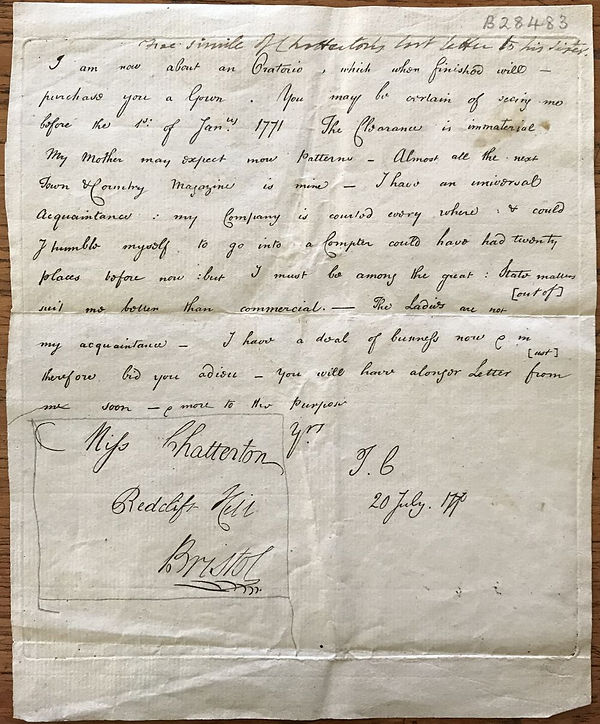
The strange thing about the engraved facsimile, above, is that it has words missing from the end of lines nine and ten, which is indicated by the spaces left by the engraver. It also has in brackets the words [out of] to be added to line 9, and the partial word [ust] to be added to the letter ‘m’ at the end of line 10. None of this makes much sense, apart from to say that Croft’s transcript has all of the words in the right place. Or did the engraver actually do what was right and etched what he saw?
Herbert Croft visited Bristol in July 1778. He was 27 years old at the time and, perhaps, struggling to finish his book, 'Love and Madness.' He needed something extra to make his book more relevant and to stand out from the crowd. He must have read Tyrwhitt’s 1777 edition of ‘Rowley’s Supposed Works’, perhaps the 1778 edition too, which is complete with the addition of an appendix proving that Chatterton was indeed the author. Chatterton was relevant, he was the hot subject, this was ideal for Croft. View my page on Herbert Croft
Croft, early on, had a direct connection to the Chatterton story; for he was the landlord of the house in Shoreditch rented by the Walmsley’s, the very house where Chatterton first lived when he arrived in London; and, give Croft his due, he talked to everyone he could find to discover what he could about Chatterton, and not only in Shoreditch but also in Holborn - proper research indeed.
His aim was to discover as much about Chatterton as he could, and, as you would expect, while in Bristol he had interviews with Catcott and with Barrett. He also met Chatterton’s mother and sister, and in the course of this meeting he managed to ingratiate himself with a gift of a guinea and a half. With this inducement and with his promise to return the letters within the hour, he was permitted to take all of Chatterton’s letters away for inspection. However, Croft departed Bristol taking the letters with him - the cad!
Read more about Chatterton in Shoreditch
It should be noted that Mary wrote to Croft on the 22 September 1778;it is an important letter with some key information about her brother, and it is written in friendly terms. Her letter shows that she was responding to a letter Croft had sent her asking for more information about her brother— the nerve of the man!
Sarah and Mary heard nothing more about Chatterton’s letters until they discovered them published in the 1780 edition of 'Love and Madness.'
When they finally got Chatterton’s letters back from Croft, they are supposed to have ‘allowed’ Croft to keep Chatterton's letter to Mary. I wonder if, in reality, Croft had a plan to include the original Ms. letter as an engraved plate in the first edition of his book, and had given the manuscript to the engraver or printer? The first test print of the engraving came back with the two errors and, time being of the essence, the decision was made to exclude the engraving.
Now, two years or so later, he was doing the right thing and returning the letters to the family. However, the letter to Mary was missing, it was either still with the engraver or the printer; I can almost hear Croft apologising profusely to Sarah and Mary, and being told he could keep the letter - for a man destined to become a Reverend, he really was taking advantage of Sarah and Mary.
The ‘engraving in facsimile’ of the letter indicates, perhaps, that the original Ms. letter was meant to be folded with Mary’s name and address forming the address section— however, it can only create a small overlap when formed into an envelope— but then, the original might have been on a larger sheet of paper. The creases on the engraving seem to show that somebody has had a go at forming it into an envelope, which when folded is quite small, at roughly 80mm x 70mm.
As a test, I printed a copy of the facsimile and folded it as best I could. It resulted in the two attached images, with Mary’s name and address on the front and ‘T.C. 20 July. 1770’ on the rear.


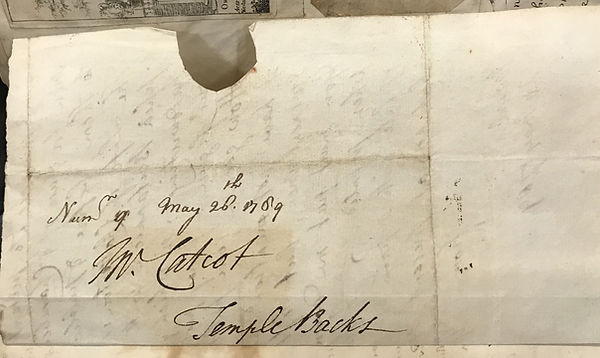
Take a look at the image attached (below). It is of the verso of a letter from William Barrett to George Catcott, dated 26 May 1789, (in the letter Barrett tells Catcott how unwell he has been— he died on October 13, 1789). The letter has the name and address on the verso, which makes it much easier to form into an envelope and then to seal it with wax or wafer.
Aged Just 17 Years 9 Months Old

Engraved in 1866 after the Tate Gallery version of The Death of Chatterton

Edward Orme engraving of the death of Chatterton after Singleton 1794.

No, this is not Chatterton. It is a young Nun and she is sleeping not dying. It's just another owner marking the back of the painting as 'Death of Chatterton.'
Engraved in 1866 after the Tate Gallery version of The Death of Chatterton
How and why did Chatterton die?
Was it accident or suicide?

Wallis's picture above, imagines scraps of Chatterton's writings on the floor, supposedly torn up in a fit of despair.
Panel 14a : ↓ Chatterton's Opium Stained Pocket-Book


How can we be sure of anything that happened 250+ years ago and counting? Well, I believe there is a consensus among those of us living in the Chatterton Universe :
-
Chatterton did not kill himself for lack of food or lack of money.
-
He was self-medicating for an STD with laudanum, or a lethal mixture of Calomel and Vitriol, and suffered an unintentional overdose, which resulted in his death.
Both Donald S.Taylor & Dr. Nick Groom have evaluated Chatterton's income and expenditure and arrived at the same conclusion, that Chatterton had ample funds to buy food and cover his other expenses, so it wasn't want that took him to the grave.
To read Donald S. Taylor's analysis of Chatterton's entries in his Pocket-Book, click the image below:
Panel 14b : ↓ Taylor's Analysis of the Pocket-Book

Panel 14c : ↓ Timeline of the Opium Stained Pocket-Book
A Chronology of the Opium Stains
-
1769: Mary, Chatterton's sister, gives the pocket-book to Chatterton, as a gift.
-
1770: On the 24th August 1770, Chatterton, according to a note by Dr Lort, buys calomel and vitriol from Cross the Apothecary. This concoction was used to treat venereal diseases - Chatterton was, at this time living in the attic of a house of ill repute.
(Calomel: A poisonous, white substance known as mercury. Vitriol is a general term for various metal sulfates, such as green vitriol (ferrous sulfate) or copper vitriol ("blue vitriol"), from which sulfuric acid ("oil of vitriol") could be derived - this information is from the internet; I would welcome clarification from an expert, (QE!).
-
1770: The Pocket-Book is found in Chatterton's room and is returned to his mother by a friend of Chatterton's, a Mr. John Oldham (Meyerstein p.421), along with Catcott's letter and some other papers, probably during September 1770.
-
1792: Sarah Chatterton dies. Mary inherits the family belongings.
-
1804: Mary, now married to a Mr Newton, 'presents' the Pocket-Book to Joseph Cottle (according to Meyerstein, p.374, Mary was on her death bed at the time). I doubt that Mary would 'present' anything, it is more likely that, with a thought for her daughter, she was paid for the 'present'. In any case, it was too late to be included in the 1803 edition of The Works of Thomas Chatterton.
-
18??: Joseph Cottle presents the Pocket Book to Bristol Museum or Library
-
1874: Walter de Gray Birch draws attention to a deep stain that had penetrated the last leaf of the book, and can be traced through nineteen leaves.
-
1907: In W. R. Barker's catalogue, the stain is described as a strong acid.
-
1947: The first analysis of the stains, were arranged by Meyerstein. I have this information from the Wedmore Memorial Lecture, which Meyerstein read in April 1947. Dr Wallis states 'I cut a piece out of the stain on the back page and tested this. It gives a positive reaction for opium alkaloids (i.e. morphine, etc.).
-
2014: Michael Doble, the chairman of the Thomas Chatterton Society, arranged for new tests to be carried out on the stains in the Pocket-Book. They can be viewed here, but, basically, they confirm that 'the spillage was indeed due to laudanum.'
So, how sure can we be that Chatterton caused the stains to the notebook?
It is safe to say that when Chatterton collected the calomel and the vitriol from Cross, they were supplied unmixed. It is reasonable to assume that he kept the 'drugs' safe by placing them in separate pockets. One of the two drugs was contained in a phial, in the liquid form of Laudanum. So, did the phial of Laudanum end up in the same pocket as his Pocket-Book, and hence no traces of any other chemical? If it is true that Chatterton was trying to treat gonorrhea, then you need to read how horrendous it could be, or, rather, how horrendous the treatment itself could be. A warning: before you click the previous link, please, if you are a male, cross your legs firmly.
The earliest mention of the opium-stains on the pages of Chatterton's pocket-book, seem to date from 1874. So what are the possibilities regarding the origin of the stains?
-
Chatterton's mother had it from 1770 - 1792.
-
His sister had it from 1792-1804.
-
Cottle had it from 1804 - to date of donation to Bristol Library.
-
What date did Cottle donate the Pocket-Book to Bristol Library?
-
Did Joseph Cottle note the condition of the book when he got it from Mary?
-
Is there really no mention of the opium stains before 1874?
-
Did the library make a note of the condition of the book when they received it from Cottle?
-
Mary, Chatterton's sister, was, for a time, confined to an asylum; did she have the little pocket-book with her - and was she treated with opium?
Panel 14d : ↓ Visitors from Bristol to the Garrett- Can the News be True Is Chatterton Dead?
Meyerstein, p.443 and ongoing pages:
"In the room where Chatterton died was found a copy of Alexander Catcott's A Treatise on the Deluge, with poems on the blank leaves at either end', and that Chatterton's 'London friends came to see the corpse, and Oldham bore the book away."
That is John Oldham, a button-seller, of the button and silk warehouse, 25 Lombard Street. He married John Lambert's sister Beliza, two years after Chatterton's death - more on this anon. Lort has much information but it requires a visit to Bristol Library in the near future B11457
Panel 14e : ↓ Herbert Croft visits Chatterton's Garrett
Herbert Croft, in Love and Madness, writing in the guise of James Hackman, very movingly describes how strongly he felt when he visited the room in which Chatterton died.

Panel 15 : ↓ The Death of Chatterton in Art - Obfuscation & Confusion
Henry Wallis's painting The Death of Chatterton is beautiful indeed, but it depicts a deeply romanticized version of Chatterton's death. To get a little closer to reality take a look at the following engravings.
Panel 15a : ↓ Edward Orme, after Henry Singleton. A Stipple Engraving, Published 1794

Published in 1794, 62 years before the painting by Henry Wallis. Note the shirt ripped asunder in anguish, the snuffed out candle, the torn manuscripts, the empty phial of poison on the floor, and the discarded shoe - now, where did Wallis get his inspiration? Note too, the Scroll on the wall where you will barely make out the word Bristol. Look closer still and explore further, use a magnifying glass if needed, or zoom in to a scarcely discernable image of - I wonder, perhaps it is of a muse holding a Lyre - a play on words mayhap! If anyone reads this engraving differently then do let me know.
Panel 15b : ↓ Bartolozzi's Engraving for the Poem Retirement, by J. H. L. Hunt


We all know that George Meredith was the model for Wallis's famous painting; but did you know that the gruesome engraving with the rats, by Bartolozzi (1727-1815), after a painting by Raphael Lamar West (1766-1850), and which was listed as The Death of Chatterton by the British Museum and the National Portrait Gallery, is not a representation of the death of Chatterton at all - or is it?
The engraving is devoid of anything representing Chatterton, no torn manuscripts, no unlit or dying candle, and no empty phial of poison - I think that sums it up and shows the image for what it is, generic.
The NPG copy of the engraving, shown above, has been taken from Juvenilia , a book of poems by J. H. Leigh Hunt. The two lines of poetry at the foot of the engraving come from Hunt's poem 'Retirement.' The two lines also appear on the page facing the engraving. It seems that the engraving only becomes a portrait of Chatterton after the addition of the handwritten annotation by some unknown hand.
We could confirm the truth of it if we had sight of Raphael Lamar West's original painting with whatever title he gave it; I have searched high and low and can find no trace of it.
However, I do have this from Wiki, referring to J. H. L. Hunts' book :
'A frontispiece by Francesco Bartollozi based on a painting by Raphael West was included in the edition based on an allegorical representation of penury from Hunt's poem "Retirement",' the note comes from Fiery Heart, by Roe, 2005.
Panel 15c : ↓ The First Night in a Convent and not the death of Chatterton.
You can now add the delightful little watercolour by John Absolon, 1815-1895, to the list. It was up for sale during 2020, and was listed by the auctioneer as 'The Death of Chatterton' simply because someone had written that title on the back of it. After a little research I found that the actual title is 'The First Night in a Convent'. The model lying in the Chatterton pose, is actually a young nun - and she is sleeping, not dying! Here's a link to the Getty site, which confirms the attribution : View

Panel 16 : ↓ Chatterton had 'The Foul Disease' ?

Rev. Lort's Ms. re Cross & Chatterton
Panel 17 : ↓ Where is Chatterton Buried ?
Was Chatterton thrown into a pauper's grave in London, or was he brought back to Bristol and buried in the family grave in St Mary Redcliffe churchyard ?
The less romantic among us would go with the general consensus, which is that he was buried in a pauper's grave in the burial ground of Shoe Lane Workhouse.
Even though we have 'proof' that Shoe Lane was Chatterton's first resting place. There is nothing to stop the first visitors from Bristol arranging to have him brought home - why else would they have gone there? Sometimes it is worth considering emotions alongside 'proof.'
To sum up ; where Chatterton rests is open to conjecture!
However, the cemetery at Shoe-Lane Workhouse was built over in the 1880s, with all the remains of the poor unfortunates, being moved to the St Andrew's Gardens burial ground (Gray's Inn Road), which is associated with St Andrew's Church (extra-parochial), Holborn Viaduct, London, EC4.
As is my way, I rest ready to be corrected, so if you know better do let me know.

The Shoe Lane Resurrection Stone

The rather gruesome sculpture, shown above, is known as The Resurrection Stone. It depicts cherubs calling the dead from their coffins. These days it is over a doorway at St Andrew's Church, Holborn. But, in earlier times, and during Chatterton's internment, it was over the doorway of the paupers burial ground in Shoe Lane, Holborn. The little snippet above is cut from The Annual Register for 1766, published in 1767.
The sculpture first came to my notice via the Flickering Lamps website, where more excellent images of the sculpture can be seen.
Some questions remain unsolvable, but Sherlock Homes had the right idea; 'when you have excluded the impossible whatever remains, however improbable, must be the truth'. I only mention Holmes because there is a scene in a Sherlock Holmes movie with Sherlock lying on a bed in an attic room in the Wallis pose - coincidental or intentional?
Panel 18 : ↓ The Death of Chatterton (Sherlock Holmes as Chatterton)

Howe woe-be-gone, how withered, forwynd, deade!
Film stock from the 2009 film 'Sherlock Holmes, Holmes for the Holiday' staring Robert Downey Jr., Jude Law, & Rachel McAdams : View
A Word of Warning ↓
If you know anything of the career of the murderer and American forger & murderer, Mark Hofmann, you will know that practically everything can be forged and everyone can be fooled! His counterfeiting shenanigans should give you pause for thought!
Hofmann was in Bristol in 1973 for his two-year Mormon mission. While in Bristol he bought a 17th-century King James Bible from a shop on the Christmas Steps and used it in one of his frauds upon the The Church of Jesus Christ of Latter-day Saints (LDS).
It is likely that Chatterton was one of Hofmann's inspirations and is why he chose Bristol for his mission. While here he had a habit of stealing blank pages from antiquarian books and it is certain that he helped himself to blank pages from books in our own Bristol Library and used them to create his forgeries. We also know that antiquarian books have gone missing, but if Hofmann was the cause is unknown.