
Thomas Chatterton Manuscript Project
Chatterton's Last Letter Home
20 July 1770, to his sister.

The above is from p.446, v3, of the 1803 edition of The Works of Thomas Chatterton The source for the above is Herbert Croft's book Love and Madness, 1780
CHATTERTON’S LAST LETTER HOME was to his sister Mary, dated 20 July 1770.
From the date of this letter, Chatterton was still four months short of his eighteenth birthday, and had just 35 days left to live.
The first line of the letter to his sister is charming, and it says much about Chatterton :
“I am now about an Oratorio, which when finished will purchase you a gown.”
Chatterton clearly loved his family, a fact that can be witnessed by reading the few letters he wrote home. The human side of all this should not be overlooked.
The promise in the letter to his sister would have delighted her, but would it really have allayed any fears she and her mother had about Chatterton being alone in the monstrous metropolis of London? I should add that the ‘Oratorio’ mentioned by Chatterton has never been found — if it ever existed.
This little essay could easily have the subtitle :
HERBERT CROFT TAKES ADVANTAGE OF THE CHATTERTON FAMILY.
The original manuscript of Chatterton's letter is lost, but we do have a transcript of it, which first appeared, without permission, in the 1780 edition of Herbert Croft’s book, Love and Madness; Chatterton’s poems start on p.149, and Chatterton’s letters start on p.168. Chatterton’s letter to his sister is on p.187 (image below).

We also have a rather mysterious ‘engraving in facsimile’ of the letter— see image below. It is in the Chatterton collection held by Bristol Library. The facsimile is not mentioned by Taylor or by Meyerstein [these two people were the main writers on Chatterton in the 1930s and 1970s], so it would be helpful if any of our readers could throw some light upon it.
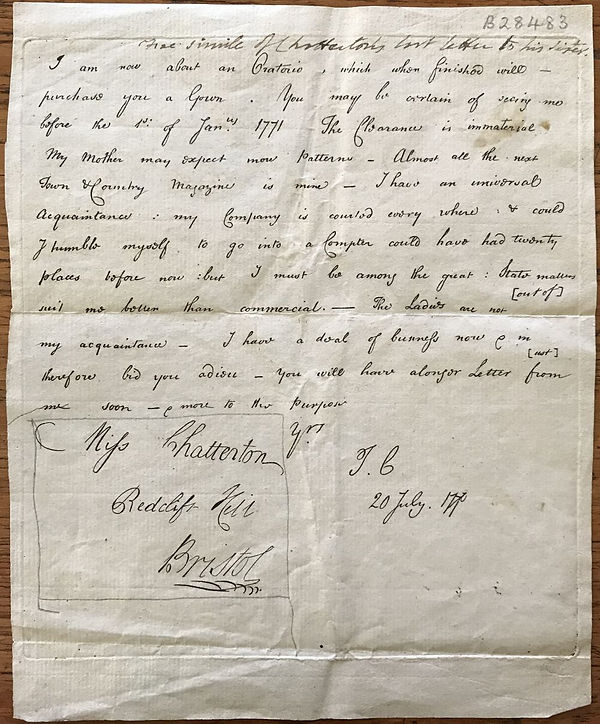
The strange thing about the engraved facsimile, above, is that it has words missing from the end of lines nine and ten, which is indicated by the spaces left by the engraver. It also has in brackets the words [out of] to be added to line 9, and the partial word [ust] to be added to the letter ‘m’ at the end of line 10. None of this makes much sense, apart from to say that Croft’s transcript has all of the words in the right place. Or did the engraver actually do what was right and etched what he saw?
Herbert Croft visited Bristol in July 1778. He was 27 years old at the time and, perhaps, struggling to finish his book, 'Love and Madness.' He needed something extra to make his book more relevant and to stand out from the crowd. He must have read Tyrwhitt’s 1777 edition of ‘Rowley’s Supposed Works’, perhaps the 1778 edition too, which is complete with the addition of an appendix proving that Chatterton was indeed the author. Chatterton was relevant, he was the hot subject, this was ideal for Croft. View my page on Herbert Croft
Croft, early on, had a direct connection to the Chatterton story; for he was the landlord of the house in Shoreditch rented by the Walmsley’s, the very house where Chatterton first lived when he arrived in London; and, give Croft his due, he talked to everyone he could find to discover what he could about Chatterton, and not only in Shoreditch but also in Holborn - proper research indeed.
His aim was to discover as much about Chatterton as he could, and, as you would expect, while in Bristol he had interviews with Catcott and with Barrett. He also met Chatterton’s mother and sister, and in the course of this meeting he managed to ingratiate himself with a gift of a guinea and a half. With this inducement and with his promise to return the letters within the hour, he was permitted to take all of Chatterton’s letters away for inspection. However, Croft departed Bristol taking the letters with him - the cad!
Read more about Chatterton in Shoreditch
It should be noted that Mary wrote to Croft on the 22 September 1778;it is an important letter with some key information about her brother, and it is written in friendly terms. Her letter shows that she was responding to a letter Croft had sent her asking for more information about her brother— the nerve of the man!
Sarah and Mary heard nothing more about Chatterton’s letters until they discovered them published in the 1780 edition of 'Love and Madness.'
When they finally got Chatterton’s letters back from Croft, they are supposed to have ‘allowed’ Croft to keep Chatterton's letter to Mary. I wonder if, in reality, Croft had a plan to include the original Ms. letter as an engraved plate in the first edition of his book, and had given the manuscript to the engraver or printer? The first test print of the engraving came back with the two errors and, time being of the essence, the decision was made to exclude the engraving.
Now, two years or so later, he was doing the right thing and returning the letters to the family. However, the letter to Mary was missing, it was either still with the engraver or the printer; I can almost hear Croft apologising profusely to Sarah and Mary, and being told he could keep the letter - for a man destined to become a Reverend, he really was taking advantage of Sarah and Mary.
The ‘engraving in facsimile’ of the letter indicates, perhaps, that the original Ms. letter was meant to be folded with Mary’s name and address forming the address section— however, it can only create a small overlap when formed into an envelope— but then, the original might have been on a larger sheet of paper. The creases on the engraving seem to show that somebody has had a go at forming it into an envelope, which when folded is quite small, at roughly 80mm x 70mm.
As a test, I printed a copy of the facsimile and folded it as best I could. It resulted in the two attached images, with Mary’s name and address on the front and ‘T.C. 20 July. 1770’ on the rear.


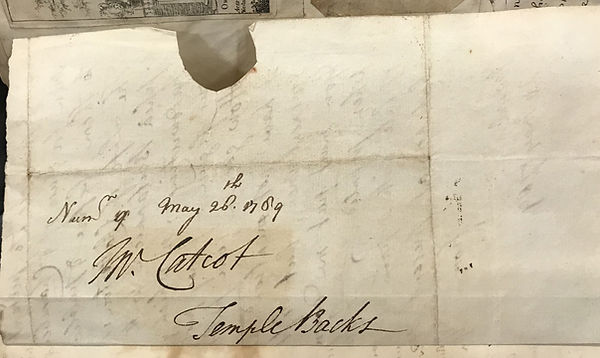
Take a look at the image attached (below). It is of the verso of a letter from William Barrett to George Catcott, dated 26 May 1789, (in the letter Barrett tells Catcott how unwell he has been— he died on October 13, 1789). The letter has the name and address on the verso, which makes it much easier to form into an envelope and then to seal it with wax or wafer.
I await the views of my talented readers.
Links :
https://www.thomaschatterton.com/contact-form : Message me here.
https://www.thomaschatterton.com/thomas-chatterton-biography-m2 : A list of Biographies etc.
https://www.thomaschatterton.com/love-and-madness-herbert-croft : Herbert Croft & his ‘Love and Madness.’
https://www.thomaschatterton.com/correspondence-family-friends : Chatterton’s Correspondence.
https://www.thomaschatterton.com/george-symes-catcott : George Symes Catcott page.
https://www.thomaschatterton.com/william-barrett : William Barrett page
https://www.youtube.com/watch?v=subq01u80TI : How to fold a letter in the 18th c.
Post by (QE!) Risteard O’Fionnalláin : https://www.thomaschatterton.com/
This page is just for John Carroll